What Is a Class 1 Licence? Category C+E Explained
A Class 1 licence is Category C+E. It lets you drive an articulated lorry at up to 44 tonnes. Here is what that means.
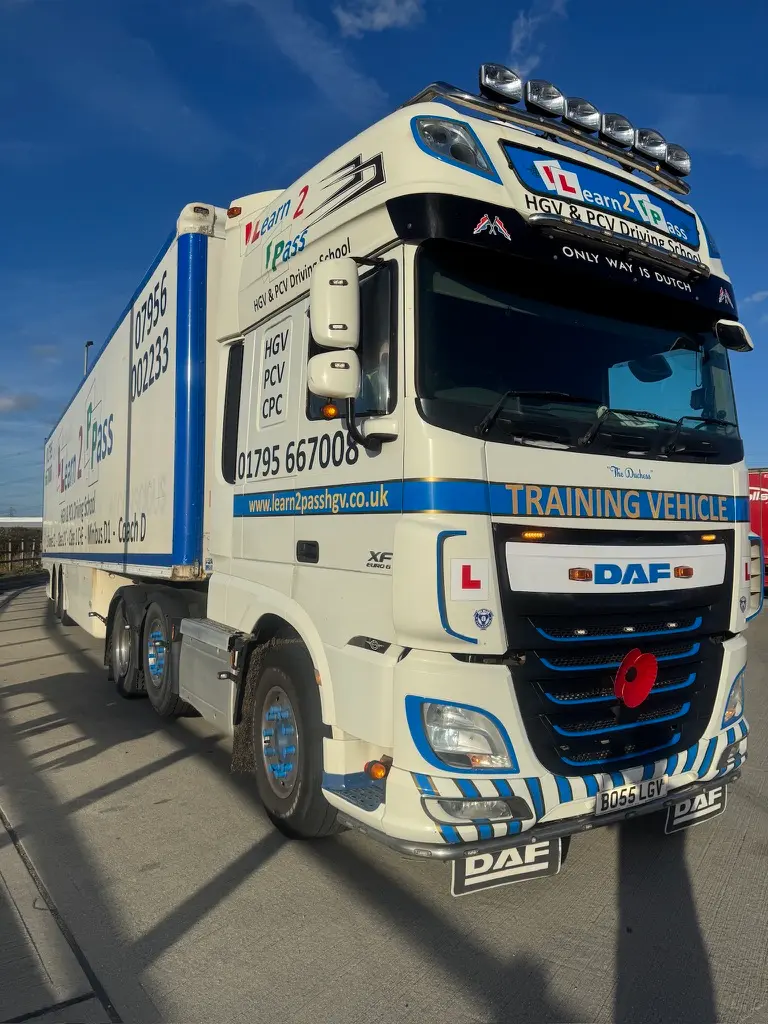
A Class 1 licence lets you drive an articulated lorry — a tractor unit pulling a full-size trailer — at up to 44 tonnes. Its official name is Category C+E. Class 1 is what drivers and job adverts say, Category C+E is what appears on your licence, and they mean exactly the same thing.
It is the highest standard licence in UK road haulage, and the one supermarket distribution, trunking and long-distance operators recruit for.
What can you actually drive on Class 1?
Category C+E is Category C plus a trailer over 750kg. In practice that means the artic: a tractor unit coupled to a semi-trailer by a fifth wheel, the lorry that bends in the middle, running at up to 44 tonnes.
It also covers drawbar combinations, where a rigid lorry tows a separate trailer on a bar rather than a fifth wheel. Parcel networks and some general haulage fleets run these.
Because C+E contains Category C, a Class 1 licence also lets you drive everything a Class 2 driver can. You give up nothing by upgrading.
What can't you drive?
Buses and coaches. Passenger vehicles are a separate licence family — Category D for full-size buses and coaches, D1 for minibuses up to 16 seats. No amount of HGV entitlement lets you carry passengers commercially.
You also cannot carry dangerous goods without an ADR certificate, which is a separate qualification on top of your licence rather than part of it.
Class 1 or Category C+E — what is the difference?
None. Two names for the same licence.
"Class 1" comes from the pre-1997 licensing system and survived because it is quicker to say. "Category C+E" is the current official term and the one printed on your photocard. Employers use both, sometimes in the same advert, and "artic driver" means the same again.
Do you need Class 2 before Class 1?
Yes. Category C+E is legally an upgrade — you have to hold Category C before you can sit the C+E test. There is no route that skips it.
What you can skip is the pause in the middle. A Car to Class 1 course runs both stages back to back as one programme, so you go from car licence to artic without stopping to find rigid work first. It is faster and cheaper than booking the two stages separately, and it is the right route if you already know artic work is what you want.
If you already hold Class 2, you only need the C+E upgrade.
How do you get a Class 1 licence?
Starting from a car licence, the full sequence is six steps.
1. Be 18 or over and hold a full UK car licence.
2. Pass a D4 medical. A doctor checks eyesight, blood pressure and anything else affecting your fitness to drive professionally.
3. Apply for provisional HGV entitlement on the D2 form, sent to the DVLA with your completed D4.
4. Pass the theory test — multiple choice and hazard perception, plus Driver CPC Part 2 case studies.
5. Pass the Category C practical test, plus Driver CPC Part 4.
6. Pass the Category C+E practical test — off-road manoeuvres including coupling and uncoupling, then an on-road drive.
If you already hold Class 2 with a valid Driver CPC, you go straight to step six. Your medical, provisional entitlement and theory pass are already in place, as long as none has expired — a theory pass is valid for two years.
How much does a Class 1 licence cost?
If you are upgrading from Class 2, our training price is £1,295 + VAT, or £1,709 all in including the DVSA off-road exercises and on-road driving tests.
If you are starting from a car licence, the Car to Class 1 route is £2,706 all in, covering both stages of training and the DVSA test fees.
Your D4 medical and theory test fee sit on top of both. We publish these figures so you can compare them properly — a headline price that does not say what is excluded is not a price you can compare. Full breakdown on our courses and pricing page.
How long does it take?
The C+E upgrade is five days of training. Most drivers coming from Class 2 are licensed within four to eight weeks, and most of that is waiting on DVSA test availability rather than training days.
From a car licence, eight to twelve weeks is realistic for the full route.
What do Class 1 drivers earn?
Class 1 drivers in Kent typically earn over £40,000 a year, with experienced artic drivers on £55,000 to £60,000. Night trunking and tramping work pay more again, because the hours are less sociable.
The gap over Class 2 is real but it is not free money — artic work usually means longer distances and more nights away. A lot of drivers weigh the extra pay against being home each evening and choose accordingly.
Class 1 or Class 2 — which should you get?
Take Class 1 if you want maximum earning potential, the widest choice of employers, and you are comfortable with distance work.
Take Class 2 if you want local multi-drop, construction or waste work, home most nights, and the fastest cheapest route to a paid driving job.
Neither is a wrong answer, and Class 2 is never wasted — it is a prerequisite for Class 1 anyway. Our full Class 1 vs Class 2 comparison goes through it properly.
Frequently asked questions
Can I go straight from a car licence to Class 1?
Not in a single test. You must pass Category C first. But you can do both stages as one continuous course without stopping in between, which is what Car to Class 1 is.
How heavy is a Class 1 lorry?
Up to 44 tonnes gross for a standard articulated combination on UK roads. The tractor unit alone is around 8 tonnes.
Is Class 1 hard to pass?
The reversing exercise is harder than Class 2 because you are steering a trailer that pivots. Coupling and uncoupling is a procedure to learn rather than a skill to master. Drivers who already hold Class 2 usually find the on-road element straightforward.
Does a Class 1 licence expire?
The entitlement must be renewed at 45 and every five years after that, with a medical each time. Separately, your Driver CPC needs 35 hours of periodic training every five years.
Do I need Driver CPC as well?
Yes, if you drive professionally. The licence lets you drive the vehicle; the Driver Qualification Card lets you be paid for it. Driver CPC has not been scrapped, despite what you may have read.
What is the minimum age for Class 1?
18, provided you hold or are working towards Driver CPC. Without CPC the minimum is 21.
Where to start
If you already hold Class 2, our Category C+E training course is five days on full-size articulated vehicles at our Sittingbourne centre, testing at Gillingham on the routes you have trained on.
If you are starting from a car licence, Car to Class 1 takes you through both stages in one programme.
Call 01795 667 008 and we will map out the timeline and tell you honestly which route costs you less.